Exercise on questionnaire selection
Questionnaire selection
Please read the Exercise instructions tab first. Then answer the questions in the ‘Questions’ tab.
Your research group is planning a randomized controlled trial (RCT) to evaluate a work-focused intervention versus distribution of an advice booklet for patients with work-related chronic low back pain (CLBP). The trial’s primary outcome is self-reported physical function.
You have identified the Work Rehabilitation Questionnaire (WORQ), available in a validated Danish version. Before selecting WORQ for your RCT, you want to determine whether its measurement properties are adequate for your purpose.
We will base our appraisal on the following study:
Hansen A, Lauridsen HH, Escorpizo R, Søgaard K, Søndergaard J, Schiøttz-Christensen B, et al. Reliability and Construct Validity of the Work Rehabilitation Questionnaire Domains in Patients with Persistent Low Back Pain. J Occup Rehabil. 2024 Nov 8;1–11.
The WORQ questionnaire can be downloaded here
Start with the questions in tab 1. Your trial and, when finished, continue to the next.
Please write your answers to the questions in a Word document. The exercise including answers can be downloaded after the course as a html-document from the webpage.
Questions
1.1 Using the exercise instructions and the information in the PROM-selection vodcast:
What do you want to measure in your trial?
What is the measurement aim (i.e. discriminative, evaluative, or predictive) of the PROM in this RCT?
What does that imply in terms of which measurement properties are important to look at?
Questions
2.1 What are the underlying constructs measured by WORQ in patients with low back pain, and how are they operationalised?
2.2 How does WORQ fit the purpose of your RCT?
2.3 Is WORQ a generic or disease-specific PROM? How should we classify its physical function subscale?
The Hansen et al. study aimed to evaluate the Danish WORQ’s measurement properties, specifically reliability and construct validity, to support its use in assessing work-related functioning.
Questions
3.1 COSMIN properties
Which measurement properties does Hansen et al. evaluate and how is each evaluated (i.e. which coefficients are reported)?
Which relevant properties are not evaluated?
3.2 In which patient population was WORQ evaluated in Hansen et al.?
3.3 What practical considerations (feasibility) support using WORQ (Physical Function domain) in our RCT? What does not support its use?
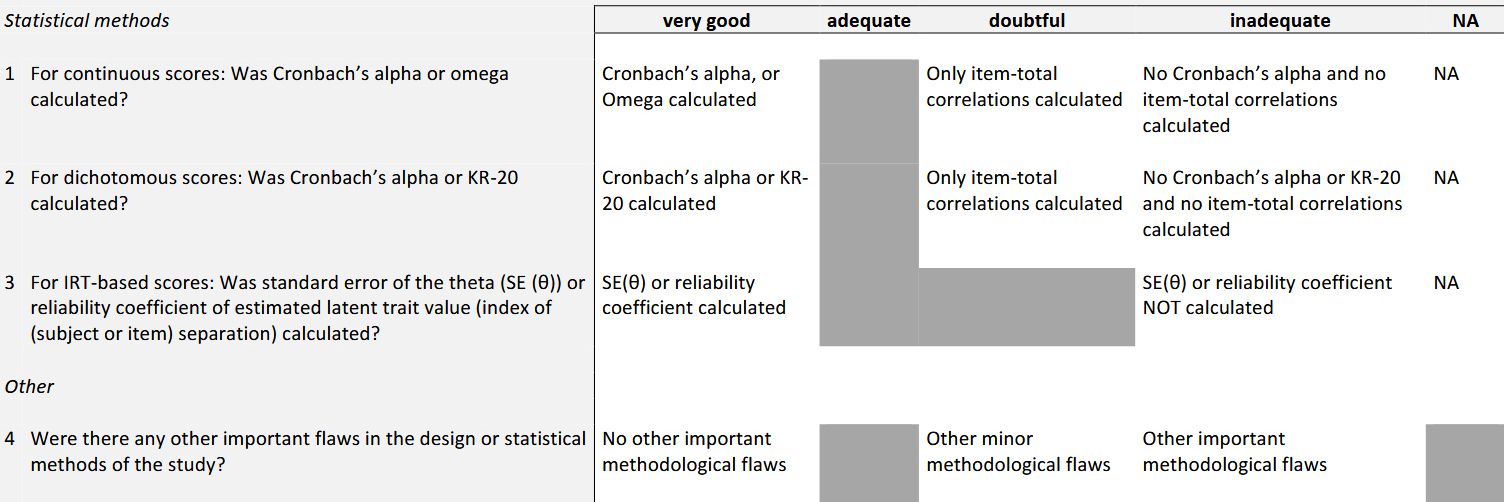
Next, you decide to look closer at the measurement properties of internal consistency and reliability. You use the COSMIN Risk of Bias checklist for this, and first you look at ‘Box 4. Internal consistency’.
Questions
3.4 What do you need to consider before evaluating Box 4 on internal consistency?
To answer this you need to look in the COSMIN Risk of Bias manual. You can find it here: COSMIN RoB manual 2.0. Find the section on ‘Internal consistency’.
3.5 Based on COSMIN Box 4 (internal consistency), how does Hansen et al. score on each of the four checklist items? Justify your answer.
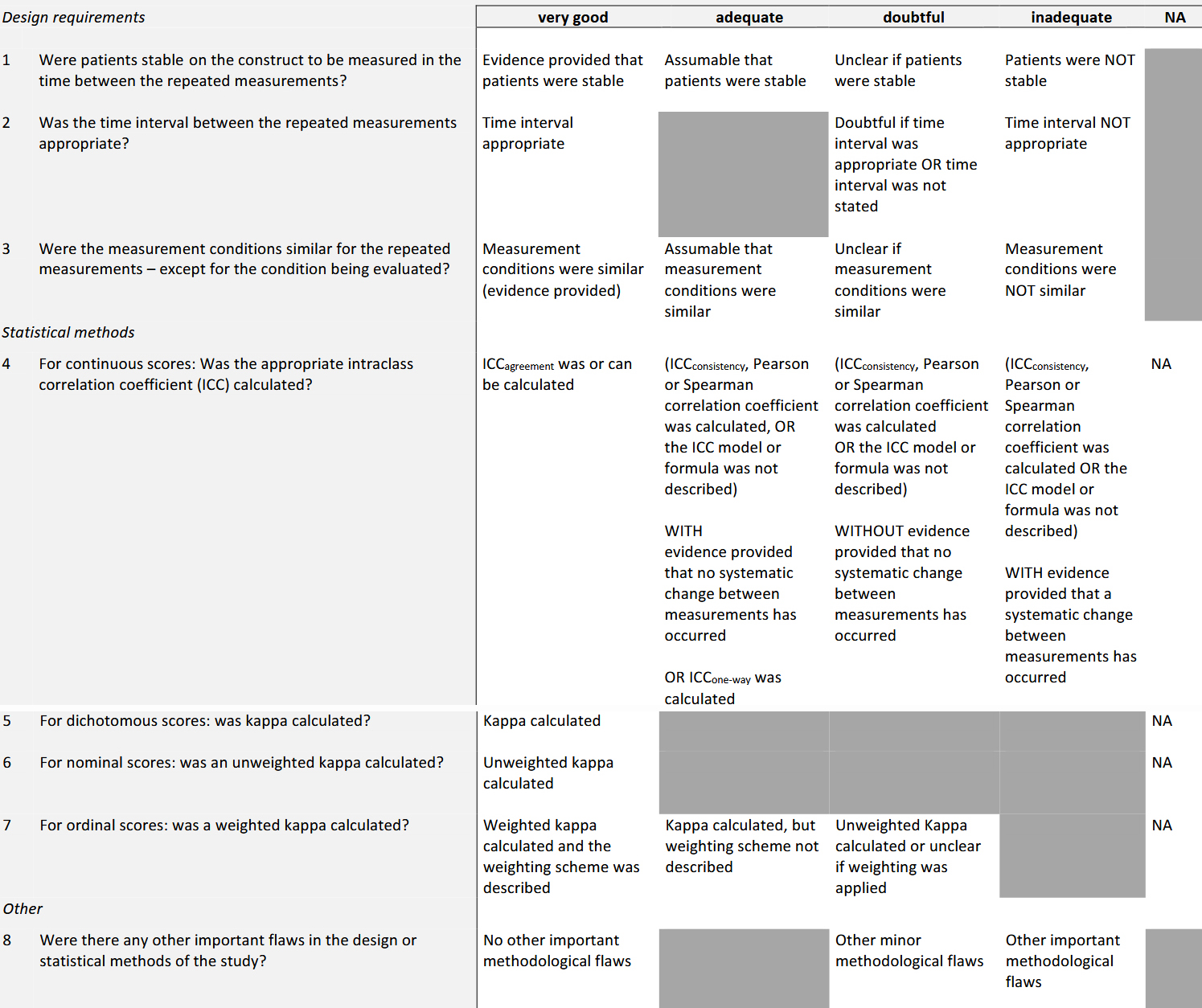
Lastly, you turn to evaluating the reliability of WORQ. Here you use Box 6. Reliability from the COSMIN RoB checklist.
Questions
3.6 Using COSMIN Box 6 (Reliability), score all eight items for Hansen et al. and justify each rating.
3.7 Based on what you have learned from this article, do you think the WORQ would be appropriate as a primary outcome for your RCT? Give reasons for your answer.